




Mumbai Campus
Chairperson, Centre for Science, Technology and Society , School of Habitat Studies
Professor, Centre for Urban Policy and Governance , School of Habitat Studies
M.Phil. (Applied Economics, CDS, JNU)
PhD ( MCRC, JMI, New Delhi)
 manjula[at]tiss[dot]ac[dot]in

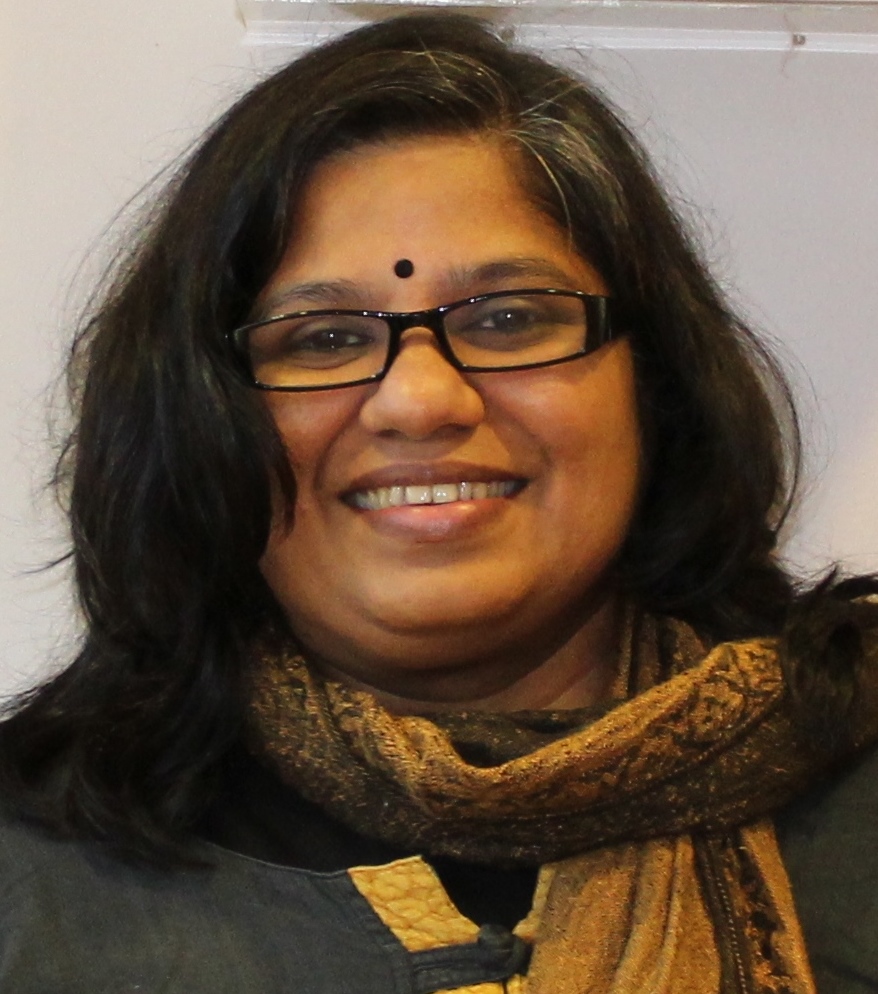
Manjula Bharathy
Professor
Centre for Urban Policy & Governance
School of Habitat Studies
email: manjula@tiss.ac.in
Phone: 022 9920045101
whatsapp: 9349761488
Manjula Bharathy is Professor at the Centre for Urban Policy and Governance in the School of Habitat Studies, Tata Institute of Social Sciences (TISS), Mumbai. For over three decades, she has combined teaching, research, and field action to advance decentralized governance, feminist political ecology, climate justice, and epistemic transformations.
Her scholarship bridges political philosophy, historical epistemology, social vulnerability& climate resilience and gendered citizenship, with a focus on women, tribals, transgender, and coastal communities. She has designed and taught courses on feminist theory, governance, research methodology, urban spaces and climate change, always committed to making complex ideas accessible and transformative.
Dr. Bharathy’s leadership has shaped important interventions. As Chief Operating Officer of Kudumbashree Mission—one of the world’s largest women’s collectives—she played a key role in designing and developing gender programmes and modules that have since been replicated across India and internationally. She was later awarded the Fulbright Fellowship in Gender Studies at Rutgers University, USA, where she deepened her engagement with feminist theory and global discourses on gender and governance. Her pioneering micro-level planning initiatives in Kerala and Ladakh created new pathways for participatory democracy in tribal and vulnerable regions.
Dr. Bharathy has led numerous field action projects that have resulted in significant government interventions, policy changes, and official orders. Most recently, the Government of Kerala issued an order on January 30, 2026, recognizing climate-aggravated flooding as a disaster—an outcome of collective interventions led by Prof. Bharathy from TISS.
Professor Manjula Bharathy’s recent book, Brick by Brick: Democratising Local Governance, explores the philosophical foundations of participatory planning through the landmark People’s Plan Campaign in Kerala. The Kerala University Syndicate has now directed that the book be translated into Malayalam and introduced as a textbook for postgraduate and doctoral students, marking a significant step in democratizing governance education. Her co-edited volume Tribal World: Shifting Boundaries and Contested Terrains explores the invisibility of tribal subjectivities in mainstream archives.
Dr. Bharathy has served on national policy committees, including the Expert Committee on Decentralised Planning for Sixth Schedule Areas (V. K. Ramachandran Committee) and the Central Advisory Committee on Panchayati Raj—both appointments made by the President of India. Her contributions have informed district planning frameworks and strengthened democratic decentralisation across India. In addition, she was a member of the Working Committee on Gender and the Marginalised of the Kerala State Planning Board, where she advised on inclusive planning and gender-sensitive policy interventions.
She is currently leading a pioneering project to develop a gender-inclusive, community-driven District Climate Action Plan in Raigad, Maharashtra, in collaboration with the State Climate Action Cell, Maharashtra, University of Toronto India Foundation, community-based knowledge partners, and policy think tanks. She also led a rights-based climate resilience project in Kerala, producing gender and community counter-maps that empowered coastal communities to claim agency in climate adaptation—recognized as one of India’s pioneering subaltern interventions in climate change.
Beyond academia, Dr. Bharathy is an award-winning documentary filmmaker. Her film XXWhy, on transgender lives, premiered internationally and won multiple national and international awards for Best Documentary. Her works on elected women representatives and gender issues continue to inspire grassroots governance movements. Her documentary Climate Resilience: Life as Told by Women was selected for the African Human Rights Film Festival and the Fulbright International Film Festival, further amplifying community voices in global forums.
Dr. Bharathy has lectured globally, including at the London School of Economics, University of Toronto, University of Rosario, and leading universities across the United States, bringing Indian experiences of democratic decentralisation, feminist governance, and climate resilience to international audiences.
Research Interests
Dr. Manjula Bharathy’s research interests span the intersections of gender, governance, climate resilience, and epistemic justice, with a focus on how marginalized communities experience, negotiate, and resist exclusionary forms of development and socio-spatial transformation.
She is particularly engaged in exploring:
Gender and the City: Examining how urban spaces are produced and contested, and how women, transgender persons, and other marginalized groups experience and reshape the politics of everyday urban life.
Gender and Climate Change: Investigating gendered vulnerabilities and agency in climate adaptation, with emphasis on community-driven frameworks such as gender counter-mapping that challenge dominant epistemologies and foreground subaltern resilience.
Gender and Water, Sanitation, and Local Governance: Analyzing how gendered subjectivities shape access to basic services, and how inclusive governance models can transform everyday practices of water and sanitation management.
Tribals and Decentralised Governance: Studying indigeneity, the politics of othering, and planning in Fifth and Sixth Schedule Areas, with attention to how tribal communities negotiate state structures and assert their rights to self-governance.
Coastal Communities and Climate Change: Documenting and theorizing community-led adaptation strategies, particularly through participatory counter-mapping, which has informed government orders and policy frameworks in Kerala and Maharashtra.
Socio-Cultural Studies of the Habitat: Engaging with identity politics, subjectivities, and the cultural dimensions of habitat, to understand how communities articulate belonging, resistance, and transformation in the face of ecological and social change.
Methodologically, Dr. Bharathy is committed to innovative qualitative approaches that center lived experience, participatory knowledge production, and community storytelling. Her work consistently seeks to democratize research by integrating grassroots epistemologies into policy and practice, thereby advancing inclusive and transformative frameworks for governance and development in the Global South.
Publications
Books
Bharathy, M. (2022). Brick By Brick: Democratising Local Governance in Kerala. Government of Kerala. ISBN: 9789354397806
Bharathy, M. (Ed.). (2022). Tribal Development in India: Shifting Boundaries, Contested Terrains. Tata Institute of Social Sciences. ISBN-10: 9391897177
Books in Regional Language
Bharathy, M. (2018). Aadivasikalum Vikeendritha Aasuthranavum (Indigenous People and Decentralised Planning). The State Institute of Languages, Kerala.
Bharathy, M. (2018). Kudumbhasreeyum Keralithinte Vikasana Prasnangalum (Kudumbashree Movement and Development Questions of Kerala). The State Institute of Languages, Kerala.
Monographs
Sivanna, N., Bharathy, M., & Gayathridevi, K. G. (2016). Engendering Local Governance: A Case from Rural Karnataka. Social and Economic Change Monographs, No. 49. Institute for Social and Economic Change, Bangalore.
Selected Articles
Bharathy. (2026). Coastal Voices Turn the Tide: How High-Tide Flooding Became a Recognised Disaster in Kerala. The IDEM. February 14, 2026
https://theaidem.com/en-coastal-voices-turn-the-tide-how-high-tide-flooding-became-a-recognised-disaster-in-kerala/#:~:text=Coastal%20Voices%20Turn,February%2014%2C%202026
Bharathy, M. (2025). Democratizing inclusive planning: Insights from the people’s plan campaign in Kerala, India. Critical Policy Studies. https://doi.org/10.1080/19460171.2025.2488803
Bharathy, M. (2024). Towards gender-responsive interventions in climate change-induced high-tide flooding in coastal regions of Kerala. Impact and Policy Research Review (IPRR), 3(1), 8–14. https://iprr.impriindia.com/wp-content/uploads/2024/07/I2_Towards-Gender-Responsive-Interventions-in-Climate-Change-Induced-High-Tide-Flooding-in-Coastal-Regions-of-Kerala_-Manjula-Bharathy_IPRR-V3-I1-2024.pdf
Bharathy, M. (2024). Climate change needs a feminist lens. India Development Review. June 13. https://idronline.org/contributor/manjula-bharathy/
Bharathy, M. (2024). Kerala’s coastline crisis: Rising seas, disappearing land, and women on the frontlines. Policy Insights for Informed Governance. July 17. https://www.policycircle.org/opinion/kerala-facing-coastline-crisis/
Bharathy, M. (2023). A mission with a difference. Kerala Calling, Government of Kerala, Vol. 43, July 4. https://www.prd.kerala.gov.in/sites/default/files/inline-files/Kerala%20Calling%20July%202023%20LR-2.pdf
Bharathy, M. (2016). Negotiating the politics of presence: Gendered citizenship and rural local governance in Maharashtra. In K. Raman Pillai, R. K. Suresh Kumar, & P. Sukumaran Nair (Eds.), Panchayat Experiences in India. Kalpaz Publications, New Delhi.
Bharathy, M. (2016). Democratic decentralisation in Rajasthan: A historical overview. In K. Raman Pillai, R. K. Suresh Kumar, & P. Sukumaran Nair (Eds.), Panchayat Experiences in India. Kalpaz Publications, New Delhi.
Bharathy, M. (2014). Intersubjectivity to consensus: Engendering rural local governance in Bihar. In M. K. Jha & Pushpendra (Eds.), Traversing Bihar: The Politics of Development and Social Justice. Orient BlackSwan, New Delhi.
Bharathy, M. (2012). Gendered citizenship for deepening local democracy: A study of ten villages in Maharashtra. In G. Palanithurai (Ed.), Elected Women Representatives and Empowerment. Sage Publications.
Bharathy, M. (2012). Objects, participants and subjects: Democratic decentralisation in Kerala. In E. Pinnington & D. Schugurensky (Eds.), Learning Citizenship by Practising Democracy: International Initiatives and Perspectives. Cambridge University.
Bharathy, M. (2011). Negotiating the politics of presence: Gendered citizenship and rural local governance in Maharashtra. Social Science in Perspective, 2(3–4), 377–406.
Bharathy, M. (2010). Feminisation of invisibility and the politics of presence. Indian Journal of Social Work, 71(4), 517–536.
Bharathy, M. (2008). Tribals and decentralisation. In Status of Panchayats in India. IRMA.
Bharathy, M. (2006). Euphoria of social capital: A re-reading. IASSI Quarterly, 21(3).
Research Reports
· 2025 – Mumbai Speaks: Civic Engagement in 227 Electoral Wards
This study mapped civic engagement across Mumbai’s 227 electoral wards, documenting how citizens interact with governance structures in everyday life. It highlighted patterns of participation, exclusion, and emerging forms of urban citizenship. The report provides insights into strengthening democratic accountability in metropolitan contexts.
· 2025 – Localisation of SDG in Shedadasi Gram Panchayat, Raigad District
This project developed a framework for localising the Sustainable Development Goals (SDGs) at the Gram Panchayat level. It emphasized gender-inclusive and community-driven approaches to planning, linking global goals with local realities. The report is a pioneering example of integrating SDGs into decentralized governance in Maharashtra.
· 2022 – No One is Here: Politics of Subjectivity – A Study of Kudumbashree in Kerala
This ethnographic study examined the politics of subjectivity within Kudumbashree, Kerala’s women’s collective. It explored how women negotiate identity, agency, and invisibility in governance spaces. The report contributes to feminist political ecology by foregrounding lived experiences of women in grassroots institutions.
· 2014 – Mediated Governance for Counter-Hegemony? Study on Green Kerala Express
This report analyzed the Green Kerala Express, a televised social reality show designed to democratize governance discourses. It examined how mediated governance can challenge hegemonic narratives and create counter-publics. The study remains one of the earliest explorations of media as a tool for participatory governance.
· 2012 – Engendering Power Spaces for Deepening Democracy: Study of Kudumbashree in Kerala
This study investigated Kudumbashree as a transformative space for women’s empowerment and democratic deepening. It documented how collective action reshaped governance structures and expanded women’s agency. The report became a reference point for gendered governance models replicated across India.
· 2011 – With and Against: Engendering Rural Local Governance in Karnataka
This ethnographic study explored how women negotiate power in Karnataka’s Panchayati Raj institutions. It highlighted tensions between formal structures and informal practices of governance. The report contributed to comparative insights on gendered citizenship across states.
· 2011 – With and Against: Engendering Rural Local Governance in Rajasthan
This report examined women’s participation in Rajasthan’s Panchayati Raj system, focusing on historical and socio-political contexts. It revealed how gendered subjectivities shape governance outcomes in rural settings. The study added depth to understanding decentralisation in northern India.
· 2010 – With and Against: Engendering Rural Local Governance in Bihar
This study analyzed women’s experiences in Bihar’s Panchayati Raj institutions. It highlighted the challenges of negotiating patriarchal structures while asserting democratic rights. The report contributed to debates on gendered citizenship and rural democracy in eastern India.
· 2008 – Negotiating the Politics of Presence: Gendered Citizenship and Rural Local Governance in Maharashtra
This report documented how elected women representatives in Maharashtra navigate the politics of presence in local governance. It examined the interplay between visibility, agency, and structural constraints. The study remains a foundational work on gendered citizenship in India.
· 2007 – Thoray: Block Development Report
This report provided a comprehensive development plan for Thoray Block, integrating participatory planning methods. It emphasized community voices in shaping local development priorities. The study contributed to strengthening block-level governance frameworks.
· 2006 – Panchayat Development Report of Leh
This pioneering report focused on micro-level planning in Leh, Ladakh. It documented participatory approaches to planning in tribal and vulnerable regions. The study informed national debates on decentralisation and contributed to Dr. Bharathy’s later role in the Ramachandran Committee on Sixth Schedule Areas.
Research Projects
- Gender-Inclusive, Community-Driven District Climate Action Plan, Raigad, Maharashtra
2026–2029 (Ongoing)
Implemented under the State Climate Action Cell of Maharashtra, supported by the University of Toronto India Foundation, and in collaboration with ASAR, Waatavaran, PDAG, and community-based partners. This project develops a gender-inclusive, community-driven District Climate Action Plan that localises the SDGs in Raigad. It foregrounds participatory climate governance, ensuring women, tribals, and marginalized groups are central to adaptation strategies.
- Mapping Citizen Engagement in Urban Local Governance in 227 Electoral Wards, Mumbai
2023–Present (Ongoing)
This project maps citizen participation and engagement across 227 electoral wards in Mumbai. It examines how urban residents interact with governance structures, highlighting patterns of inclusion, exclusion, and accountability.
- Localisation of SDGs in Shedashi Gram Panchayat, Raigad District
2025 (Completed)
As Project Director, Dr. Bharathy led the development of a framework for localising the SDGs at the Gram Panchayat level. The project emphasized participatory planning, gender inclusion, and community ownership of development priorities. It demonstrated how global goals can be translated into local governance practices, creating replicable models for other districts.
- Gender Counter-Mapping in Coastal Kerala
2021–Present (Ongoing)
Supported by the United States-India Educational Foundation (USIEF), this project develops a new methodological framework of Gender Counter-Mapping to explore, map, and analyze the agency and voice of marginalized communities in climate discourses. Applied in Kerala’s coastal regions, it advances rights-based approaches to adaptation and climate justice, contributing to the landmark Government of Kerala order (January 30, 2026) recognizing high-tide flooding as a disaster.
- Understanding Mediated Governance: A Study of Green Kerala Express
2014–2016 (Completed)
This project analyzed Green Kerala Express, the first televised social reality show on Doordarshan designed to select the best-performing Local Governance Institutions in Kerala. It explored how mediated governance can democratize discourses, challenge hegemonic narratives, and create counter-publics.
- Engendering Power Spaces for Deepening Democracy: Study of Kudumbashree in Kerala
2012–2014 (Completed)
Funded by the Government of Kerala, this project investigated Kudumbashree as a transformative space for women’s empowerment and democratic deepening. It documented how collective action reshaped governance structures and expanded women’s agency, informing gendered governance models replicated across India.
- Comparative Studies on Engendering Governance in Bihar, Rajasthan, and Karnataka
2009–2011 (Completed)
Funded by the Royal Norwegian Embassy, these comparative studies examined women’s participation in Panchayati Raj institutions across three states. They highlighted tensions between formal structures and informal practices of governance, contributing to national debates on gendered citizenship and decentralisation.
- Participatory Citizenship and Gendered Governance in Maharashtra
2008 (Completed)
Funded by The Hunger Project, New Delhi, this study documented how elected women representatives in Maharashtra navigate the politics of presence in local governance. It examined the interplay between visibility, agency, and structural constraints, offering foundational insights into gendered citizenship in India.
- Thoray Block Development Report in Leh
2007 (Completed)
This project provided a comprehensive development plan for Thoray Block, integrating participatory planning methods. It emphasized community voices in shaping local development priorities and strengthened block-level governance frameworks with the support from Tata Trust
- Micro-Level Planning of the Gurja Project (Development Support to Leh)
2006 (Completed)
Funded by the Jamsetji Tata Trust, this pioneering project focused on participatory planning in Leh, Ladakh. It documented micro-level planning approaches in tribal and vulnerable regions, informing national debates on decentralisation and contributing to Dr. Bharathy’s later role in the V. K. Ramachandran Committee on Sixth Schedule Areas, constituted by the President of India.
Impacts of Research Interventions
2026–2029 – Raigad District Climate Action Plan, Maharashtra
Dr. Bharathy spearheaded the Raigad research project from TISS in collaboration with the State Climate Action Cell (SCAC) and knowledge partners including ASAR, Waatavaran, and PDAG, with support from UTIF. Building on her earlier SDG localisation work in Shedashi GP, this project is pioneering a gender-inclusive, community-driven framework for climate adaptation. It positions women and marginalized groups at the center of climate governance, making Raigad a model for integrating SDGs into district-level climate action.
2026 – Kerala Government Order on Coastal High-Tide Flooding
On January 30, 2026, the Government of Kerala issued G.O. (Ms) No.5/2026/DMD, officially recognizing coastal high-tide flooding/sea incursion as a State-Specific Disaster. This landmark order was the outcome of collective work by academic institutions, community-based organisations, and the state bureaucracy, with Dr. Bharathy spearheading the effort from TISS. It ensures thousands of coastal families can now access relief under the State Disaster Response Fund (SDRF), marking a historic shift in disaster governance.
2023–2025 – Localisation of SDG Framework in Shedashi GP, Maharashtra
Dr. Bharathy directed the localisation of SDGs in Shedashi Gram Panchayat, Raigad District. The framework emphasized participatory planning, gender inclusion, and community ownership of development priorities. This work directly informed the design of the Raigad Climate Action Plan (2026–29), linking global goals to local governance practices.
2021–Present – Gender Counter-Mapping in Coastal Kerala
Dr. Bharathy developed a new methodological framework of Gender Counter-Mapping to explore, map, and analyze the agency and voice of marginalized communities in climate discourses. Applied in Kerala’s coastal regions, this rights-based approach foregrounds adaptation strategies rooted in lived experience and justice. It has become a pioneering tool for integrating gender and community perspectives into climate planning and climate justice debates.
2013–2015 – Kudumbashree Mission (Chief Operating Officer)
During her tenure as COO, Dr. Bharathy made key contributions to pioneering gender-focused interventions. These included the Gender Self-Learning Program, Gender Crime Mapping developed with Kudumbhasree, and training modules on mobility, community theatre, and anti-human trafficking. She also helped establish a Postgraduate Development Program for 40 Kudumbhasree members, creating a cadre of community researchers. Importantly, her earlier research study on the Green Kerala Express (2014)—the first social reality show on Doordarshan to select the best-performing Local Governance Institutions in Kerala—helped her conceptualise and design a similar social reality show for Kudumbhasree , democratizing governance discourses through India’s largest women’s collective.
2008–2010 – Central Advisory Committee on Panchayati Raj (PRI), Government of India
Dr. Bharathy’s research on gender and rural local governance led to her appointment as a member of the Central Advisory Committee on Panchayati Raj (PRI), constituted by the President of India. Serving alongside Prof. Niraja Jayal, she contributed to key policy recommendations that strengthened democratic decentralisation and gender-sensitive governance across India.
2006–2008 – Micro-Level Planning (MLP) in Leh and Kerala
Through participatory planning under the Tata-LAHDC programme, Dr. Bharathy developed models for tribal and vulnerable regions. This work led to her induction into the V. K. Ramachandran Committee on Decentralised Planning for Sixth Schedule Areas, constituted by the President of India. Her contributions to this national committee shaped policy recommendations on district planning and influenced frameworks for democratic decentralisation in tribal regions.
Field Action Projects
Women Initiatives in Climate Action Network (WICAN), Kerala
2021–Present
Dr. Bharathy spearheaded the creation of the Women Initiatives in Climate Action Network (WICAN) in Kerala, a collective platform amplifying the voices of coastal women in climate justice discourses. WICAN emerged as a counterpublic, enabling women from marginalized communities to articulate their lived experiences of climate vulnerability and to shape adaptation strategies through a rights-based approach. The initiative integrates Gender Counter-Mapping methodologies to foreground agency, resilience, and community-led knowledge in climate planning. WICAN has since become a critical intervention in democratizing climate governance, ensuring that women’s perspectives are central to both local and state-level climate action frameworks.
Non-Formal Learning Homes (NFLH) among Paniyar Communities, Kerala
2013–2014
As Chief Operating Officer of Kudumbashree, Dr. Bharathy conceived and led the Non-Formal Learning Homes (NFLH) project under the Satha Dina Programme, financed by the Scheduled Tribes Department, across 100 Paniya colonies in Wayanad, Kannur, Malappuram, and Kozhikode. The initiative established community kitchens managed by tribal women’s NHGs, providing three meals a day to vulnerable groups, while simultaneously creating learning homes in community spaces to support toddlers and school dropouts.
Tribal women and youth were trained as non-formal teachers, with 74 teachers appointed across the four districts. At its peak, 951 children attended NFLHs, where they were introduced to Malayalam literacy, storytelling, and a friendly schooling environment to ease their transition into formal education. The project also integrated community sanitation campaigns and vegetable cultivation in 48 hamlets, linking nutrition, education, and empowerment. NFLH demonstrated a holistic rights-based approach to tribal development, combining food security, education, and community resilience.
Micro-Level Planning (MLP) in Leh, Ladakh
2004–2008
Dr. Manjula Bharathy conceptualised and conducted Micro-Level Planning (MLP) in different blocks of Leh District, Jammu and Kashmir, as part of the Tata–Ladakh Autonomous Hill Development Council (LAHDC) Development Support Programme. She produced reports on People’s Initiatives in Leh and created orientation and conscientisation documentaries to capture the participatory planning process. In recognition of this pioneering work, she was nominated as a member of the Expert Committee on Decentralised Planning for Sixth Schedule Areas, constituted by the Government of India.
Project Reports (Published by TISS and Approved by Funding Agencies)
Mumbai Speaks: Civic Engagement in 227 Electoral Wards
2025
This project mapped citizen engagement across 227 electoral wards in Mumbai, analyzing participation, accountability, and civic inclusion in urban local governance.
Localisation of SDGs in Shedashi Gram Panchayat, Raigad District
2025
Developed a framework for localising the Sustainable Development Goals (SDGs) at the Gram Panchayat level. The project emphasized participatory planning, gender inclusion, and community ownership, creating replicable models for other districts.
Panchayat Development Report of Leh
2006
Prepared under the Tata-LAHDC programme, this report documented participatory planning approaches in Leh, Ladakh. It contributed to national debates on decentralisation and informed policy frameworks for tribal regions.
Thoray: Block Development Report
2007
Produced a comprehensive development plan for Thoray Block, integrating participatory planning methods. It emphasized community voices in shaping local development priorities and strengthened block-level governance frameworks.
Negotiating the Politics of Presence: Gendered Citizenship and Rural Local Governance in Maharashtra
2008
Funded by The Hunger Project, this study examined how elected women representatives navigate visibility, agency, and structural constraints in local governance. It remains foundational to understanding gendered citizenship in India.
With and Against: Engendering Rural Local Governance in Bihar
2010
Funded by the Royal Norwegian Embassy, this comparative study analyzed women’s participation in Panchayati Raj institutions in Bihar, highlighting tensions between formal structures and informal practices of governance.
With and Against: Engendering Rural Local Governance in Karnataka
2011
Part of the comparative studies funded by the Royal Norwegian Embassy, this project examined gendered participation in Panchayati Raj institutions in Karnataka, contributing to national debates on decentralisation.
With and Against: Engendering Rural Local Governance in Rajasthan
2011
This study, also funded by the Royal Norwegian Embassy, explored women’s roles in Panchayati Raj institutions in Rajasthan. It documented challenges and innovations in gendered governance.
Engendering Power Spaces for Deepening Democracy: Study of Kudumbashree in Kerala
2012
Funded by the Government of Kerala, this project investigated Kudumbashree as a transformative space for women’s empowerment and democratic deepening. Its findings informed gendered governance models replicated across India.
Mediated Governance for Counter-Hegemony? Study on Green Kerala Express
2014
Analyzed Green Kerala Express, the first televised social reality show on Doordarshan to select the best-performing Local Governance Institutions in Kerala. The study explored how mediated governance can democratize discourses and create counter-publics.
Courses Designed & Taught
Qualitative Research Methodology
State , Law & Governance
Socio- Cultural Perspectives of Habitat Studies
Gender and the City
Gender inclusive WASH
Peri-Urban Turn in the Global South: Space, Power, and Subaltern Urbanisms
Media and the Reimagining of the South Asian Cites
Gender, Social Vulnerability and Climate change ( this course is presently discontinued)
Engendering Local Governance (CBCS- this course is presently discontinued)
Political Economy of the Media ( Taught for 5 years in SMCS, TISS)
Media and Mediated Governance ( Taught for 5 years in SMCS, TISS)
Development Communication and Participative Development ( Taught for 5 years in SMCS, TISS)
Innovative Teaching Program: Postgraduate Diploma in Development Praxis
2013–2015
As Chief Operating Officer of Kudumbashree, Dr. Manjula Bharathy conceived and implemented the Postgraduate Diploma in Development Praxis, an innovative teaching program designed to capacitate and empower women from marginalized communities. The program was specifically targeted at Kudumbashree members and their graduate children, most of whom came from Below Poverty Line (BPL) households and belonged to Scheduled Castes, Scheduled Tribes, and Other Backward Classes.
A cohort of 44 students was admitted to this one-year, full-time diploma program. The curriculum, meticulously designed by Dr. Bharathy, comprised 40 credits and was taught by leading academics, practitioners, and civil society organizations across Kerala. The syllabus emphasized the development experiences of Kerala and dia, while situating Kudumbashree as a rights-based intervention space that exemplifies participatory governance and collective empowerment.
Students were trained not only in theoretical frameworks but also in practical methodologies of community research and participatory development. Each student was required to produce a dissertation, and these dissertations were later consolidated into three published volumes by the Kerala State Language Institute. Notably, seven students were sponsored by the Scheduled Tribes Department, including four from Particularly Vulnerable Tribal Groups (PVTGs), ensuring representation from some of the most marginalized communities.
The program was groundbreaking in its vision: it transformed Kudumbashree members into community researchers, equipping them with the skills and knowledge to articulate subaltern agency and produce voices from below. By bridging academic rigor with grassroots experience, the Postgraduate Diploma in Development Praxis became one of the most important and innovative teaching programs initiated by TISS in Kerala. It demonstrated how higher education can be localized to empower marginalized communities, democratize knowledge production, and strengthen rights-based development discourses
Close
Search



 2026 All Rights Reserved.